Ecological Sustainability in Fine Arts Education (EcoSenda)

Aqueous Ecologies Residency, Royal Academy of Art, The Hague (KABK),
April 2026. © P. M. Dreier-Wang
The project explores the links between ecological sustainability and visual arts education – the aim is to find out how ecological issues should be addressed in art education. The approach is based on research, artistic work and close collaboration between partners. The main idea behind the project is to make the artistic process visible in the development of art education approaches.
Partner:
Academy of Media Arts Cologne (KHM)
Turku University of Applied Sciences (Turku UAS)
Estonian Academy of Arts (EKA)
Royal Academy of Art The Hague (KABK)
Timeframe:
1.10.2024 – 30.09.2027
Source of funding:
Erasmus + Cooperation Partnerships
Responsible / contact at KHM:
Pascal Marcel Dreier-Wang, M.A.
Project management & artistic lead at KHM:
Pascal Marcel Dreier-Wang, M.A., Nathan Schönewolf
Student Assistant:
Amelie Vierbuchen
Links
Seminars and Events
THE FOREST AT PLAYLUDIC ECOLOGIES SUMMER SCHOOL
LUDIC ECOLOGIES SUMMER SCHOOL
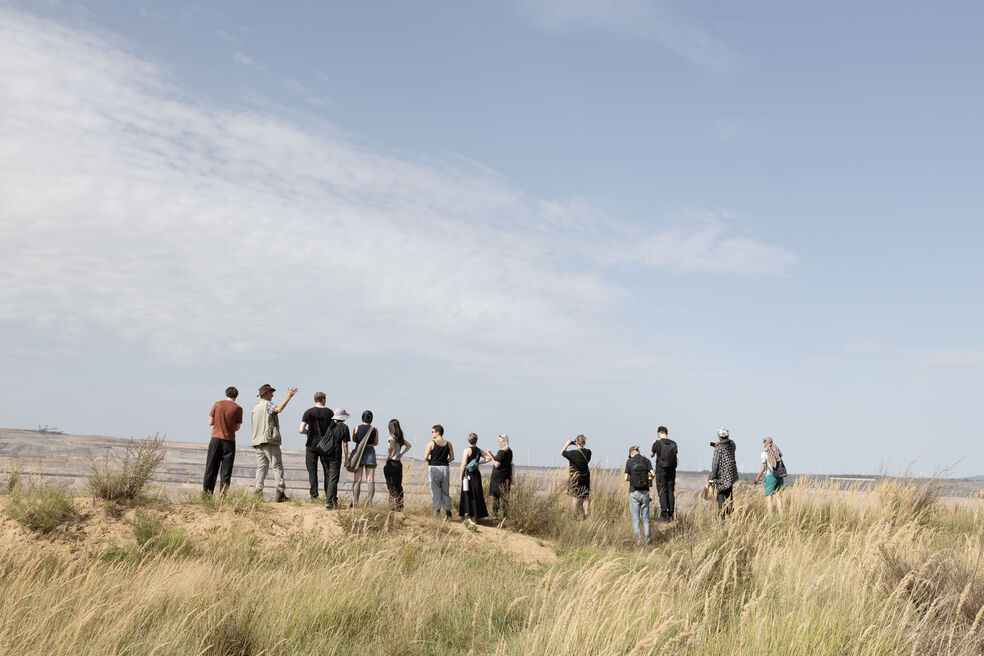
Excursion to the open pit coal mine at the edge of what remains of the Hambach forest. Guided by Michael Zobel. © P. M. Dreier-Wang
A forest ecology is a delicate one. If the forest perishes, its fauna may go with it. The Athshean word for world is also the word for forest
Ursula K. Le Guin, The Word for World Is Forest
This summer school aims to explore the friction between ludic imaginaries and the material realities of the postnatural. The participants are encouraged to unearth the less obvious entanglements of digital media, investigating how procedural and artistic literacy can expose the hidden dependencies between play, media culture history, and the various human and non-human beings—the trees, birds, wind, and soil—that sustain them.
The summer school invites us to put the traditional boundaries and concepts of the game as wel l as of Nature at play. Participants will engage in questioning how the distribution of resources like time (work), electricity, and computational power, but also the configuration of space dictates, constrains, or augments our artistic practices. They will get to know the local ecologies of the Volcanic Eifel, the extractive landscapes of open pit coal mines, as well as the resistant architectures that were built in the remaining forests.
We will get in touch with perspectives and methods of (artistic) resistance by thinking together, cooking together, making and playing together.
Organisation: P. M. Dreier-Wang and Nathan Schönewolf
Student Assistant: Amelie Vierbuchen
Workshops, Screenings, and Performances by: Corinna Duschl, Judith Röder and Akiko Ahrendt, Mathias Antlfinger, Michael Zobel, P. M. Dreier-Wang and Nathan Schönewolf.
Contact