

Links und Downloads
Themes
Themen
- Exhibition
- Awards
- Library
- Speech
- edition KHM
- Festival / Award ceremony
- FG exMedia
- FG Film und TV
- FG Kunst
- FG Kunst- und Medienwissenschaften
- Movie screening
- Glasmoog Books
- Glasmoog - Raum für Kunst und Diskurs
- KHM Journal
- Concert
- Cooperation
- LAB Jahrbuch
- LECTURE Reihe
- Teachers elsewhere
- literature
- off topic
- News articles
- Publications
- Job offers
- Study
- TV broadcast
- Event
- all
Que Faire? – My Father's Diaries
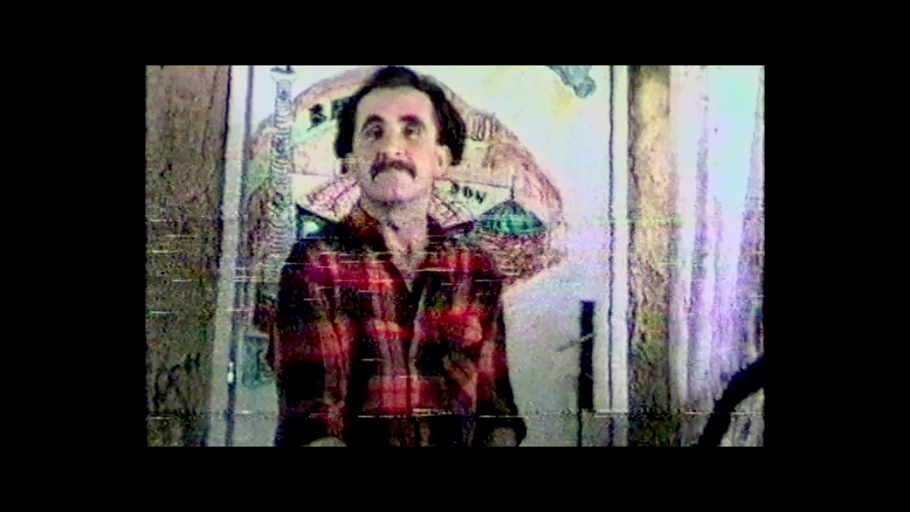
Still from "My Father’s Diaries" by Ado Hasanović
The KHM-students Irma Mečević and Amel Bešlagić invite Ado Hasanović for a conversation about his documentary film "My Father’s Diaries" as part of the seminar “Que faire? Now and then. Cinematic Strategies Against Fascistization”
Mittwoch, 25. November 2026, 19 Uhr, Aula
Aula der KHM, Filzengraben 2, 50676 Köln
Film & Gespräch / Film & Talk
Eintritt frei / Free entry
Aula der KHM, Filzengraben 2, 50676 Köln
Film & Gespräch / Film & Talk
Eintritt frei / Free entry
Irma Mečević and Amel Bešlagić, students of KHM, invite Ado Hasanović for a conversation about his documentary film "My Father’s Diaries" – a deeply personal and political work that raises a fundamental question: how can filmmaking itself become a political act?
How can a survivor make a film about genocide that goes beyond documenting atrocities and instead offer another way of confronting, remembering, and understanding their aftermath? And when personal archives become the basis for such a film, who is the film ultimately made for-the family, the survivors, history, or the public?
Through these questions, the conversation will explore the relationship between personal memory and collective history, between testimony and artistic expression, and between the responsibility to remember and the freedom to create.
The evening is part of the seminar “Que faire? Now and then. Cinematic Strategies Against Fascistization” led by Prof. Alejandro Bachmann and Prof. Philip Scheffner. The seminar description: "In his manifesto published in 1970, at a time when his own filmic work was transitioning into a more politicized phase, Jean-Luc Godard asks: What is to be done? In this seminar, we would like to address this question in light of the processes of fascistization currently unfolding all around us, and to take a closer look at, examine, and question contemporary and historical cinematic strategies aimed at countering these threatening developments. Through dialogue among ourselves and with invited guests, we aim to focus on the distinction between making political films and the political act of filmmaking, in order to understand what role(s) the medium of film plays at this moment, what forms it takes, and what function it might fulfill. The starting point for all reflections and connections to be drawn are the films themselves, supplemented by selected texts as well as active, engaged, critical, and passionate discussion about them."
"My Father’s Diaries" by Ado Hasanović
I/FR, Documentary, 2024, 83 min
English and Bosnian with english subtitles
In August 1993, Bekir Hasanović trades a gold coin for a video camera, which he uses to document daily life in Srebrenica from that point onward. The footage he captures during the war, along with his makeshift crew, Dzon, Ben & Boys, presents an unexpected portrait of a disoriented population that holds on to reality with resilience and a healthy dose of humor. Ado, Bekir’s son, uses these recordings and his father’s diaries to reconstruct his image. Together with his mother, Fatima, he seeks to understand how Bekir survived the Death March and the Srebrenica genocide. "My Father’s Diaries" is a documentary about Bekir Hasanović, the filmmaker’s father. He himself was a filmmaker and an amateur cameraman during the harsh years of the Bosnian War. He was one of the few men to survive what is known as the Death March—a 100-kilometer trek through the woods undertaken by 15,000 Bosniak Muslims trying to escape the Serbs who sought to kill them. But Bekir didn’t just shoot videos and shorts. From July 7, 1992, the day his brother Piro died, he kept a daily journal until his journey on the Death March. Ado‘s aim with this film is to combine the story told in his diaries with the footage Bekir shot back then and the material Ado filmed himself. "My Father’s Diaries" is a meta-documentary that indirectly tells the story of Ado Hasanović‘s profound struggle to talk about his father. The images are raw and unpolished, making the viewer a witness to two men confessing their suffering. The narrative unfolds in the first person, like a diary—from the difficulty of finding a way to communicate with the father, through his harrowing memories, to the gratitude of having survived.
Ado Hasanović is a Bosnian-Italian film director based in Rome. A participant of Berlinale Talents Sarajevo in 2008, he completed a program at the Norwegian Nansen Academy in 2010, focusing on interethnic dialogue. In 2013, he earned his degree in directing from the Sarajevo Film Academy. He later continued his education at the prestigious Centro Sperimentale di Cinematografia in Rome, specializing in film directing, and attended the Master’s program in Dramaturgy at the Academy of Performing Arts in Sarajevo as a guest student.
In 2024, Ado founded the Silver Frame Film Festival in Srebrenica, aimed at honoring the city and its citizens, deeply affected by the traumas of the genocide, by providing a platform for artistic expression and resilience through cinema. His short films, such as "The Angel of Srebrenica "(2010), "Mama" (2013), "Pink Elephant" (2017), "Nomofobia" (2018), and "Let There Be Colour" (2020), have been selected and awarded at many international film festivals. His first documentary, "My Father’s Diaries", produced by Palomar (Italy) and Mediawan (France), premiered in 2024 at Visions du Réel.
Links und Downloads
Themes
Themen
- Exhibition
- Awards
- Library
- Speech
- edition KHM
- Festival / Award ceremony
- FG exMedia
- FG Film und TV
- FG Kunst
- FG Kunst- und Medienwissenschaften
- Movie screening
- Glasmoog Books
- Glasmoog - Raum für Kunst und Diskurs
- KHM Journal
- Concert
- Cooperation
- LAB Jahrbuch
- LECTURE Reihe
- Teachers elsewhere
- literature
- off topic
- News articles
- Publications
- Job offers
- Study
- TV broadcast
- Event
- all