


Themes
Themen
- Exhibition
- Awards
- Library
- Speech
- edition KHM
- Festival / Award ceremony
- FG exMedia
- FG Film und TV
- FG Kunst
- FG Kunst- und Medienwissenschaften
- Movie screening
- Glasmoog Books
- Glasmoog - Raum für Kunst und Diskurs
- KHM Journal
- Concert
- Cooperation
- LAB Jahrbuch
- LECTURE Reihe
- Teachers elsewhere
- literature
- off topic
- News articles
- Publications
- Job offers
- Study
- TV broadcast
- Event
- all
Panel: "Everything Fell Apart..."
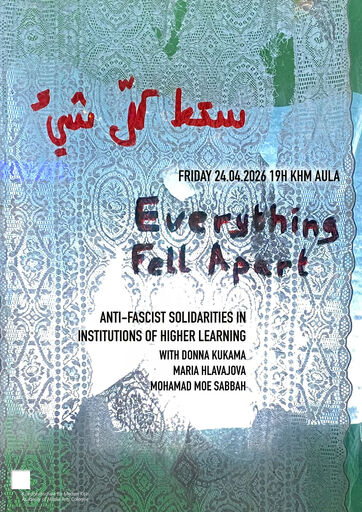
Panel on anti-fascist solidarities in institutions of higher learning*. With Maria Hlavajová, donna Kukama, Mohamad Moe Sabbah.
Freitag / Friday, 24th of April 2026, Aula, 19 Uhr / at 7 p.m.
Filzengraben 2, 50676 Köln
Eintritt frei / free entrance
Filzengraben 2, 50676 Köln
Eintritt frei / free entrance
Art schools and art institutions pride themselves in their internationality. At the same time, they’re often structurally unprepared to foster a supportive student/faculty life for all. In current fascization dynamics, art schools also have become targets of political repression and austerity politics and students have faced criminalization for expressing solidarity with people facing war, climate catastrophe, racist violence, genocide, or crimes against humanity. Art schools and other institutions of higher learning and their faculty have largely failed to support their students against these acts of aggression in meaningful ways.
In what sense can these dynamics be analyzed as part of current “recalibrations of white supremacy” (Lentin)? And how can people working or studying at institutions such as art schools create spaces of anti-fascist practice? In what ways can artistic performative practices contribute to these spaces?
The panel will be accompanied by the KHM internal workshop:
*Empty the Classroom! *
by Elena Ishchenko, Tania Licheuskaya, Mary Mikaelyan, Ivonne Sheen Mogollón
14.00–18.30, Room 2, please register, limited seats: antifascistsolidarities@khm.de
How do we define fascism today, and how can we trace its presence in our everyday lives? Can schools, and art schools in particular, confront processes of fascisation and white supremacy politics? What kinds of sustainable strategies of resistance can be built within and beyond these institutions?
We will start wondering together and building up a dialogue around different meanings and approaches to fascism. We would like to discuss together how it manifests in our present around different worldwide contexts, putting special focus on the German one.
Afterwards, we propose to trace student movements and solidarity actions from both a global and historical perspective, and focus on resilience practices within the recent history of KHM. We will look at student-led movements in countries such as Chile and Greece, alongside more recent solidarity initiatives, including actions in support of Ukraine and Palestine, such as student camps in various German cities, including Cologne and Bonn. By sharing these examples, we ask: what can we learn from them, and how can we build anti-fascist strategies that hold space for the multiplicity of student voices?
The aim of this workshop is to think collectively and to build dialogue in between the students and the mediators, to realize how influential students could be in the fight against fascism. We bring the image of an empty classroom because without them, it totally loses its purpose and meaning, and because the reality of students exists beyond the institution's walls.
Themes
Themen
- Exhibition
- Awards
- Library
- Speech
- edition KHM
- Festival / Award ceremony
- FG exMedia
- FG Film und TV
- FG Kunst
- FG Kunst- und Medienwissenschaften
- Movie screening
- Glasmoog Books
- Glasmoog - Raum für Kunst und Diskurs
- KHM Journal
- Concert
- Cooperation
- LAB Jahrbuch
- LECTURE Reihe
- Teachers elsewhere
- literature
- off topic
- News articles
- Publications
- Job offers
- Study
- TV broadcast
- Event
- all
